Drill Bushing Types Guide: ANSI P, H, SF, PM & More
Choosing the wrong drill bushing can ruin a part, slow down production, and cost your shop real money.
Whether you’re building a new drill jig or upgrading an existing fixture, understanding drill bushing types is one of the most important decisions you’ll make. The right bushing keeps your drill on target, hole after hole, shift after shift.
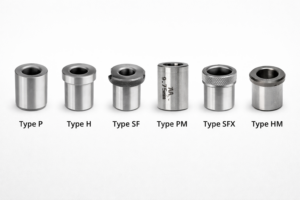
In this guide, we cover all major ANSI drill bushing types — P, H, SF, PM, SFX, and HM — so you can select the right one with confidence. You’ll also get a full breakdown of press fit vs renewable bushings and a practical selection guide for your specific production needs.
Let’s get started.
Table of Contents
- What Are Drill Bushings?
- Why Drill Bushing Types Matter in Manufacturing
- ANSI Drill Bushing Types: Full Overview
- Type P vs Type H: The Press Fit Showdown
- Press Fit vs Renewable Bushings: Full Comparison
- Renewable Bushing Selection: When and Why
- Drill Bushing Selection Guide
- Industry Applications
- 8 Bushing Types – Quick Reference Card
- FAQ
What Are Drill Bushings?
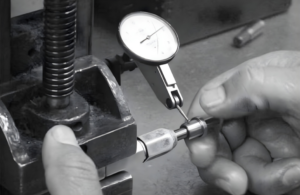
A drill bushing is a hardened steel sleeve that guides a cutting tool — like a drill, reamer, or countersink — into a workpiece at a precise location and angle.
They are installed into drill jig plates and work as a fixed guide point. Without a bushing, your drill can walk, wander, or enter at the wrong angle. Even a small error early in the process can ruin the entire part.
Drill bushings are used across industries including aerospace, automotive, medical device manufacturing, and general metalworking. They are manufactured to strict ANSI standards (specifically ANSI B94.33), which means you can rely on consistent sizes, tolerances, and interchangeability across suppliers.
Why Drill Bushing Types Matter in Manufacturing
Not all drill jig bushings are equal. The type you choose affects:
- Hole accuracy — The bushing must match the drill diameter precisely.
- Tool life — Bushings that allow lateral movement increase drill wear.
- Production volume — High-volume runs demand different bushings than one-off jobs.
- Setup time — Renewable bushings allow fast tool changes without reworking the jig.
- Cost per part — Using the wrong bushing for high-volume production increases scrap and replacement costs.
- This is why the bushing types comparison matters — it’s not just about size. It’s about fit, function, and the demands of your specific manufacturing environment.
ANSI Drill Bushing Types: Full Overview
All major drill bushing types are defined under ANSI B94.33. Here’s a clear breakdown of each type, what it does, and when to use it.
Type P — Press Fit Bushing
Type P is the most commonly used drill bushing. It has no head or flange. The bushing presses directly into the jig plate and is held in place by an interference fit.
Key features:
- Headless, flush-mount design
- Interference fit (no locking device needed)
- Compact — fits in tight spaces
- Lower cost than headed types
Best for: Low-to-medium production runs where tool changes are infrequent and space is limited.
Limitation: Removing a Type P bushing requires a press. It is not designed for frequent replacement.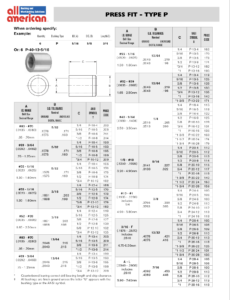
Type H — Headed Press Fit Bushing
Type H is similar to Type P but includes a flange (head) at the top. The head sits on top of the jig plate surface, which prevents the bushing from being pushed through under cutting forces.
Key features:
- Flanged top prevents downward movement
- Pressed into the jig plate — no locking device
- Better resistance to axial thrust forces
- Slightly more material cost than Type P
Best for: Applications with higher axial cutting forces, or where extra positional security is needed.
Type SF — Slip Renewable (Liner) Bushing
Type SF is a renewable bushing — it slides in and out of a permanent liner (Type PM) installed in the jig plate. The SF bushing is held in place by a locking clamp or screw, not by press fit.
Key features:
- Slips in and out of the liner — no press required
- Can be swapped in seconds
- Multiple bushing sizes can share one liner
- Requires a Type PM liner (sold separately)
Best for: High-production runs where drills wear out and need frequent replacement, or multi-operation jigs where different tool sizes are used in the same hole location.
Type PM — Press Fit Renewable Liner
Type PM is the permanent housing for renewable bushings. It presses into the jig plate once — just like a Type P bushing — and stays there for the life of the jig. Type SF or other renewable bushings then slip into the PM liner.
Key features:
- Installed once via press fit — stays permanently
- Accepts slip-fit renewable bushings (Type SF, SFX)
- Protects the jig plate from wear
- Critical component for any renewable bushing system
Best for: Any jig that will see high production volume and multiple tool changes over its lifetime.
Type SFX — Extended Slip Renewable Bushing
Type SFX is a longer version of the Type SF bushing. The extended length provides more tool guidance — especially important when drilling deeper holes or when the bushing must bridge a gap between the jig plate and the workpiece.
Best for: Applications requiring extended tool guidance, thick jig plates, or clearance situations where the standard SF length is insufficient.
Type HM — Headed Press Fit with Lock Notch
Type HM is a headed, press fit bushing with a locking notch machined into the flange. A set screw or locking clamp engages the notch to prevent the bushing from rotating under torque.
Best for: Operations with heavy side loads or where bushing rotation would compromise hole accuracy.
Type P vs Type H: The Press Fit Showdown
These two are the most commonly confused bushing types. Here’s a clear, side-by-side look.
| Feature | Type P | Type H |
|---|---|---|
| Head/Flange | No | Yes |
| Mounting Method | Press fit | Press fit |
| Axial Thrust Resistance | Moderate | High |
| Space Required | Compact | Slightly more |
| Relative Cost | Lower | Slightly higher |
| Best Use | Tight clearance areas | High-thrust applications |
The short answer: If space is tight, go with Type P. If your drill generates significant downward force — or you need extra security — choose Type H. Both are permanent and require a press for removal.
Press Fit vs Renewable Bushings: Full Comparison
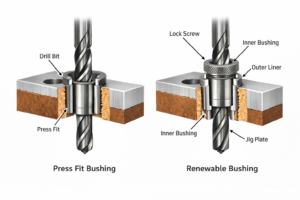
This is one of the most important decisions in drill bushing selection. The choice between press fit and renewable bushings depends on your production volume, jig complexity, and how often tools wear out.
Press Fit Bushings (Type P and H)
- Pressed permanently into the jig plate
- Extremely rigid — zero movement once installed
- Low upfront cost
- Difficult and time-consuming to replace
- Best for: low-to-medium volume production, prototype work, and dedicated jigs
Renewable Bushings (Type SF, SFX with PM liner)
- Slide into a permanent PM liner
- Can be swapped in minutes — no press required
- Higher initial cost (bushing + liner)
- Ideal for long production runs and multi-tool operations
- Best for: high-volume production, operations requiring multiple drill sizes in the same location
Which Should You Choose?
Use press fit if:
- Your production run is under ~500–1,000 parts
- The tool is unlikely to wear out before the job is done
- You need maximum rigidity and the smallest footprint
Use renewable if:
- You’re running thousands of parts
- The same hole location requires multiple tool sizes (drill, ream, countersink)
- Minimizing downtime for tool changes is a priority
Renewable Bushing Selection: When and Why
The most common question we hear: “When does it make sense to invest in a renewable bushing system?“
Here’s a practical way to think about it.
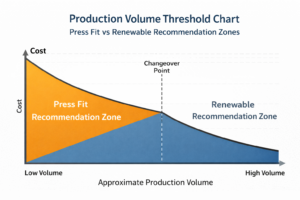
Production Volume Threshold
As a general rule of thumb:
Under 500 parts: Press fit is usually the right call. The time and cost savings from a renewable system don’t justify the setup investment.
500–2,000 parts: It depends on how many tool changes you expect and how complex the operation is. Evaluate the downtime cost of replacing a worn press fit bushing mid-run.
Over 2,000 parts: A renewable bushing system almost always pays off. The reduction in jig downtime, scrap from worn guides, and tool damage adds up quickly.
Multi-Operation Jigs
If a single jig location needs to guide a drill, then a reamer, then a countersink — a renewable system is the clear winner. You install one PM liner, then swap SF bushings sized for each tool. No pressing, no reworking the plate.
Long Jig Lifespan
If your jig is a long-term asset used across multiple production runs and product versions, renewable bushings protect the jig plate. The PM liner takes all the wear, not the jig itself.
Drill Bushing Selection Guide
Use these key factors to make your selection:
- Production Volume Low volume → press fit. High volume → renewable. (See thresholds above.)
- Number of Operations Per Hole One operation → press fit. Multiple operations (drill + ream + countersink) → renewable with PM liner.
- Tool Diameter and Tolerance Always match the bushing inside diameter to the specific cutting tool you’re using. ANSI bushings come in precise drill sizes or fractional/metric ranges.
- Material Being Drilled Harder materials generate more heat and wear. Renewable bushings are preferred for steel and alloys where tool life is shorter.
- Jig Plate Thickness Thicker plates may require extended bushings (SFX) for proper tool guidance. The rule: bushing length should be at least 1.5× the bushing inside diameter for reliable guidance.
- Space and Clearance Tight clearances → Type P (headless). More room available → Type H or SF for added security.
- Axial Thrust Force High thrust (large drills, hard materials) → Type H or HM for flange and locking support
Machinery’s Handbook or SME Manufacturing Reference
Industry Applications
Drill jig bushings are used across virtually every precision manufacturing sector. Here’s how different industries rely on specific bushing types.
Aerospace
Aerospace manufacturing demands the tightest tolerances of any industry. Renewable bushing systems are standard because airframe components are often drilled in long production runs using multiple tools per hole.
- Common types: SF, SFX, PM
- Key requirement: Zero deviation across thousands of identical parts
- Challenge: Exotic materials (titanium, composites) wear tools quickly, renewables save significant downtime
Automotive
Automotive production lines run at high volume with tight cycle times. Renewable bushings are preferred because downtime for bushing replacement is minimized.
- Common types: SF, PM, H
- Key requirement: Speed and volume, minimal interruption to production flow
- Challenge: Same jig must often accommodate multiple model variants
Medical Device Manufacturing
Medical machining requires extreme precision and full traceability. Bushings used in medical jigs must meet tight dimensional specs and be made from compliant materials.
- Common types: P, H (for precise, low-volume runs)
- Key requirement: Dimensional accuracy and documentation compliance
- Challenge: Small part sizes require miniature bushing configurations
8 Bushing Types – Quick Reference Card
Here’s your fast-reference summary of all major ANSI drill bushing types:
| Type | Head | Mounting | Renewable? | Best Use Case |
|---|---|---|---|---|
| P | No | Press fit | No | Low-volume, space-limited |
| H | Yes | Press fit | No | High thrust, added security |
| SF | No | Slip fit (in PM) | Yes | High-volume, single-tool |
| SFX | No | Slip fit (in PM) | Yes | Extended guidance needed |
| H (Renewable) | Yes | Slip fit (in PM) | Yes | Headed renewable version |
| PM | Yes | Press fit | N/A (liner) | Permanent liner for renewables |
| HM | Yes | Press fit | No | Anti-rotation, heavy torque |
| Fixed Liner | Varies | Press fit | No | Dedicated long-run operations |
Conclusion
Selecting the right drill bushing type isn’t complicated — once you know what each type is designed to do.
For most low-volume or dedicated jig work, Type P or H press fit bushings are the practical choice. For high-production environments and multi-tool operations, a renewable bushing system using Type PM liners and Type SF or SFX bushings will save you time, reduce scrap, and protect your jig investment.
The key is matching the bushing to your production reality, not just your drill diameter.
Ready to Find the Right Bushing?
Browse our full catalog of ANSI drill bushings, including press fit and renewable styles in standard and custom sizes.
→ [Shop All Drill Bushings] → [Request a Custom Quote] → [Contact Our Engineering Team]
Frequently Asked Questions
Q1: What is the difference between a press fit and a renewable drill bushing? A press fit bushing (Type P or H) is permanently installed into the jig plate using an interference fit and requires a press to remove. A renewable bushing (Type SF or SFX) slides into a permanent liner (Type PM) and can be swapped quickly without tools or a press.
Q2: What does ANSI B94.33 mean for drill bushings? ANSI B94.33 is the American National Standard that defines the dimensions, tolerances, and designations for drill jig bushings. It ensures that bushings from different manufacturers are interchangeable and meet consistent quality requirements.
Q3: How do I choose between Type P and Type H drill bushings? Choose Type P when space is limited and you need a flush, headless bushing. Choose Type H when your cutting operation generates significant downward (axial) thrust force and you need the flange to prevent the bushing from being pushed through the jig plate.
Q4: When should I use a renewable bushing system? A renewable bushing system is recommended when your production run exceeds approximately 500–1,000 parts, when multiple tool sizes are needed at the same hole location, or when minimizing downtime for tool changes is a production priority.
Q5: What is a Type PM bushing used for? A Type PM (press fit liner) is the permanent housing that stays in the jig plate for the life of the jig. It accepts slip renewable bushings (Type SF, SFX) so multiple bushing sizes can be used at the same location without reworking the jig plate.
So dive in, have fun